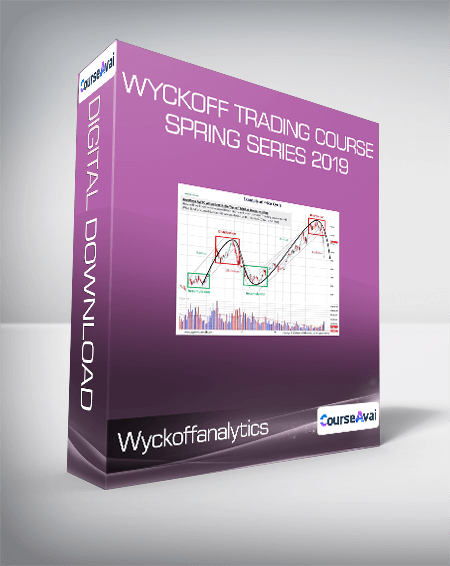
You are currently accessing the institutional-grade blueprint for Wyckoffanalytics – Wyckoff Trading Course – Spring Series 2019. Instant digital deployment and lifetime access are guaranteed immediately upon transaction clearance.
Salepage link: At HERE. Archive:
Wyckoffanalytics – Wyckoff Trading Course – Spring Series 2019

nDescription: In the first four sessions of the WTC, you will learn how to to read market structure by applying Wyckoff’s cardinal insights regarding the interplay of price, volume and time. Understanding market structure allows you to anticipate coming price action. You will learn to identify and analyze accumulation, distribution, re-accumulation and re-distribution – the key trading ranges that power trends. You will also learn Wyckoff Method trade set-ups based on market structure, how to enter a new or an existing trend, and how to recognize in advance when a trend is likely to end.nTWTR – WTC price cycle.jpgnGet Wyckoffanalytics – Wyckoff Trading Course – Spring Series 2019 downloadnThe Price Cycle: Accumulation, Mark-Up, Distribution and Mark-DownnChange of Character in an established trend: identifying a change from a trending to a non-trending environmentnChange of Character in a trading range: identifying price and volume action signaling the initiation or continuation of a trendnTrading ranges that generate big trends: accumulation and distributionnA key concept in Wyckoff Method analysis of trading ranges: PhasesnPhase anatomy: Wyckoff Method events (e.g., climaxes, tests, springs, upthrusts, signs of strength)nIdentifying phases in accumulation and distributionnCharacteristics of re-accumulation and re-distribution trading rangesnDistinguishing re-accumulation from distribution and re-distribution from accumulationnThree Wyckoff Method rules for trades based on market structurenDelineating Buying and Selling Zones using the Wyckoff Method, including entry and exit strategiesnExercises and homework assignmentsnMini-course Duration: 4 online sessionsnnDates: Monday afternoons; January 7, 14, 21 and 28nnTime: 3:00-5:30 p.m. (Pacific Time)nnCost: $998 for the entire January-April cycle (15 sessions); WTC alumni rate: $700 only for the whole course!nn“Studying Wyckoff under Roman is one of the best decisions that I have made in my life. While progressing through the Wyckoff Trading Course, I earned 15x the money that I paid for tuition.” (PL – WTC graduate)nnWTC Part II (Spring 2019) – SUPPLY AND DEMANDnnDescription: Here Mr. Bogomazov will focus in detail on identifying supply and demand on any chart. The Wyckoff Method is based on the assumption that all freely traded markets are governed by supply and demand. In today’s markets, as in Wyckoff’s time, large professional interests dominate supply and demand. Having the ability to accurately read supply and demand on a chart will allow you to make better decisions about timing your entries and exits and to join the large operators rather than being caught on the wrong side of a trade.nnConcepts in supply and demand – the forces that move all marketsnWho is the composite operator and how do his actions in the market affect supply and demand?nVolume and spread analysisnVariations of spread and volume in different market environmentsnEffort (volume) versus results (price action) – confirmation and discordance both predict future price behaviornVolume analysis and schematics in trading rangesnVolume characteristics in different phases of accumulation and distributionnWyckoff’s springboard: when price is poised to movenTradable volume patternsnExercises and homework assignmentsnMini-course Duration: 4 online sessionsnnDates: Monday afternoons; February 4, 11, 18, and 25nnTime: 3:00-5:30 p.m. (Pacific Time)nnPrerequisite: WTC Part I (Wyckoff Structural Price Analysis) or consent of instructornn“Roman, without question, your instruction is exceptional and your patience endless. You have such a mastery of this material…[and] offer exceptional value both for the knowledge and time that is made available to students. There is no doubt that you walk in the noble footsteps of Wyckoff himself: developing and sharing knowledge without reserve.” (JC – WTC graduate and current WMD participant)nnWTC Part III (Spring 2019) – RELATIVE AND COMPARATIVE STRENGTHnnDescription: Relative and comparative strength are Wyckoff Method concepts that can help you select the top stocks in the best sectors to trade, particularly at market turns. In this part of the course, you will learn how to apply these concepts to identify candidates for long or short trades, and how they can also be used to improve the timing of your entries and exits.nnRelative and comparative strength analysis: how to choose the best vehicles to tradenUse of comparative strength for stock selection in the Wyckoff MethodnImproving the Wyckoff Method’s comparative strength analysis in trading rangesnDifferences between relative and comparative performancenUsing changes in relative strength or weakness to spot sectors and stocks to tradenCreating selection filters using relative and comparative strength to identify high-probability tradesnExercises and homework assignmentsnMini-course Duration: 4 online sessionsnnDates: Monday afternoons; March 4, 11, 18, and 25nnTime: 3:00-5:30 p.m. (Pacific Time)nnPrerequisite: WTC Parts I and II (Wyckoff Structural Price Analysis and Supply and Demand) or consent of instructornn“If you want to trade and trade well, the knowledge that you gain from the WTC is invaluable. You will really understand the price/volume action of the markets.”n(DF – WTC graduate)nnWTC Part IV (Spring 2019) – PUTTING IT ALL TOGETHER: DEVELOPING A WYCKOFF TRADING PLANnnDescription: The previous sections of the WTC incorporate foundational elements of the Wyckoff Method and are designed to allow you to immediately apply standalone concepts to your own trading. For students who want to integrate these elements more deeply, Mr. Bogomazov teaches how to create a Wyckoff trading plan in the final three WTC sessions. Because the content of this section relies so heavily on materials presented previously, participation will be limited to students who have attended WTC Parts I, II and III.nnUsing filters to improve selection of stocks or options to tradenRelative strength filtersnStructural filtersnSupply and demand filtersnUsing multiple filters to pinpoint the best trades and times to open positionsnMarket Analysis as a Filter – timing entries in sync with the marketnUsing Wyckoff Method concepts to create a trading plannBack-testing your trading plan with a pre-formatted Excel template – key variables to tracknTrading tactics for your Wyckoff trading plan: entries, position management, and exitsnExercises and homework assignmentsnMini-course Duration: 3 online sessionsnnDates: Monday afternoons; April 1, 8 and 15nnTime: 3:00-5:30 p.m. (Pacific Time)nnPrerequisite: WTC Parts I, II and III, or consent of instructornnGet Wyckoffanalytics – Wyckoff Trading Course – Spring Series 2019 downloadTrading foreign exchange and algorithmic assets on margin carries a high level of risk and may not be suitable for all investors. Past performance does not guarantee future results.