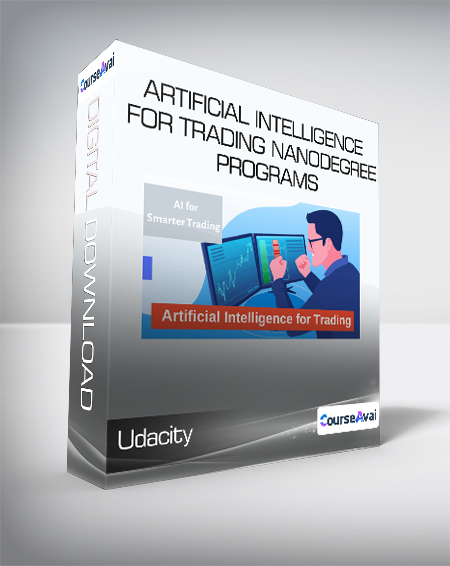
You are currently accessing the institutional-grade blueprint for Udacity – Artificial Intelligence for Trading Nanodegree Programs. Instant digital deployment and lifetime access are guaranteed immediately upon transaction clearance.
Salepage link: At HERE. Archive:
Udacity – Artificial Intelligence for Trading Nanodegree Programs

nnWhat You Will LearnnSyllabusnQuantitative TradingnnLearn the basics of quantitative analysis, including data processing, trading signal generation, and portfolio management. Use Python to work with historical stock data, develop trading strategies, and construct a multi-factor model with optimization.nnHide detailsnnEstimated 6 months to completennBasic Quantitative TradingnnLearn about market mechanics and how to generate signals with stock data. Work on developing a momentum-trading strategy in your first project.nTrading with momentumnAdvanced Quantitative TradingnnLearn the quant workflow for signal generation, and apply advanced quantitative methods commonly used in trading.nBreakout StrategynStocks, Indices, and ETFsnnLearn about portfolio optimization, and financial securities formed by stocks, including market indices, vanilla ETFs, and Smart Beta ETFs.nSmart Beta and Portfolio OptimizationnFactor Investing and Alpha ResearchnnLearn about alpha and risk factors, and construct a portfolio with advanced optimization techniques.nAlpha Research and Factor ModelingnSentiment Analysis with Natural Language ProcessingnnLearn the fundamentals of text processing, and analyze corporate filings to generate sentiment-based trading signals.nSentiment Analysis using NLPnAdvanced Natural Language Processing with Deep LearningnnLearn to apply deep learning in quantitative analysis and use recurrent neural networks and long short-term memory to generate trading signals.nDeep Neural Network with News DatanCombining Multiple SignalsnnLearn advanced techniques to select and combine the factors you’ve generated from both traditional and alternative data.nCombine Signals for Enhanced AlphanSimulating Trades with Historical DatannLearn to refine trading signals by running rigorous back tests. Track your P&L while your algorithm buys and sells.nBacktestingnnNeed to prepare?nnNew to Python programming? Check out our free Intro to Data Analysis course.nnNeed to refresh your statistical and algebra knowledge? Check out our free Intro to Statistics and Linear Algebra courses.nIcon – Dark upwards trend arrownData-driven investments have doubled in 5 years, to $1 trillion in 2018.nAll Our Programs IncludennReal-world projects from industry expertsnnReal-world projects from industry expertsnWith real world projects and immersive content built in partnership with top tier companies, you’ll master the tech skills companies want.nTechnical mentor supportnnTechnical mentor supportnOur knowledgeable mentors guide your learning and are focused on answering your questions, motivating you and keeping you on track.nPersonal career coach and career servicesnnPersonal career coach and career servicesnYou’ll have access to career coaching sessions, interview prep advice, and resume and online professional profile reviews to help you grow in your career.nFlexible learning programnnFlexible learning programnGet a custom learning plan tailored to fit your busy life. Learn at your own pace and reach your personal goals on the schedule that works best for you.nProgram OfferingsnEnrollment includes:nClass contentnContent co-created with WorldQuantnReal-world projectsnProject reviewsnProject feedback from experienced reviewersnStudent ServicesnTechnical mentor supportnNewnStudent communitynImprovednCareer servicesnPersonal career coachingnNewnInterview preparationsnResume servicesnGithub reviewnLinkedIn profile reviewnSucceed with Personalized ServicesnWe provide services customized for your needs at every step of your learning journey to ensure your success!nExperienced Project ReviewersnTechnical Mentor SupportnPersonal Career CoachnGet personalized feedback on your projectsnReviews By the numbersn2000+ project reviewersn1.8M projects reviewedn4.85/5 reviewer ratingsn3 hour avg project review turnaround timenReviewer ServicesnnPersonalized feedbacknUnlimited submissions and feedback loopsnPractical tips and industry best practicesnAdditional suggested resources to improvennLearn with the bestnCindy LinnCindy LinnnCurriculum LeadnnCindy is a quantitative analyst with experience working for financial institutions such as Bank of America Merrill Lynch, Morgan Stanley, and Ping An Securities. She has an MS in Computational Finance from Carnegie Mellon University.nArpan ChakrabortynArpan ChakrabortynnInstructornnArpan is a computer scientist with a PhD from North Carolina State University. He teaches at Georgia Tech (within the Masters in Computer Science program), and is a coauthor of the book Practical Graph Mining with R.nElizabeth Otto HamelnElizabeth Otto HamelnnInstructornnElizabeth received her PhD in Applied Physics from Stanford University, where she used optical and analytical techniques to study activity patterns of large ensembles of neurons. She formerly taught data science at The Data Incubator.nEddy ShyunEddy ShyunnInstructornnEddy has worked at BlackRock, Thomson Reuters, and Morgan Stanley, and has an MS in Financial Engineering from HEC Lausanne. Eddy taught data analytics at UC Berkeley and contributed to Udacity’s Self-Driving Car program.nBrok BucholtznBrok BucholtznnInstructornnBrok has a background of over five years of software engineering experience from companies like Optimal Blue. Brok has built Udacity projects for the Self Driving Car, Deep Learning, and AI Nanodegree programs.nParnian BarekatainnParnian BarekatainnnInstructornnParnian is a self-taught AI programmer and researcher. Previously, she interned at OpenAI on multi-agent Reinforcement Learning and organized the first OpenAI hackathon. She also runs a ShannonLabs fellowship to support the next generation of independent researchers.nJuan DelgadonJuan DelgadonnContent DevelopernnJuan is a computational physicist with a Masters in Astronomy. He is finishing his PhD in Biophysics. He previously worked at NASA developing space instruments and writing software to analyze large amounts of scientific data using machine learning techniques.nLuis SerranonLuis SerranonnInstructornnLuis was formerly a Machine Learning Engineer at Google. He holds a PhD in mathematics from the University of Michigan, and a Postdoctoral Fellowship at the University of Quebec at Montreal.nCezanne CamachonCezanne CamachonnCurriculum LeadnnCezanne is a machine learning educator with a Masters in Electrical Engineering from Stanford University. As a former researcher in genomics and biomedical imaging, she’s applied machine learning to medical diagnostic applications.nMat LeonardnMat LeonardnnGet Udacity – Artificial Intelligence for Trading Nanodegree Programs downloadnnInstructornnMat is a former physicist, research neuroscientist, and data scientist. He did his PhD and Postdoctoral Fellowship at the University of California, Berkeley.nTop Student Reviewsn4.6nn(350)nEduardo P.nnI loved the program. The first 3 projects were very basic, but everything after project 4 was great. You get introduced to alpha research, portfolio optimization and backtesting. In some of the projects you use Zipline, Quantopian’s open source library. While of course, it’s not expected for them to provide trading strategies to you, the applications of AI to trading seem relevant. You use neural networks, NLP, and random forests, among other models, in ways that are appliable to real trading research. Most of the instructors from Udacity do a very good job explaining the courses concepts, both theory and programming. The first 3 projects touch some subjects very briefly and without much depth, which was a bit disappointing, but understandable because of the breath of knowledge required for Quantitative Trading. The pace after project 4 picks up considerably though, and you get a challenging sequence with many subjects and approaches that were new for me, as well as suggestions to deepen your knowledge. The instructors they brought from the industry were excellent too.nHsin-Wen C.nnI received a lot of great advice from Udacity reviewers which I haven’t arranged a time to continue to organize project portfolio video demo with the reviews. And I should write each project a readme to demonstrate what I know and speak for each project, I work through. It matched my need in the part of the healing of my heart and soul like a puppy, sleep, meditation and Godzilla and the machine learning section give me a lot of lift. It’s about Thanksgiving, I want to tell Udacity thank you for guiding me to enroll this Nanodegree program :D! It is super worth this journey. I have a great life during this Nanodegree program.nAnunay b.nnIts a great program, I already knew most of the things from the AI Algorithms section but the Quantitative Trading section helped me understand how stock markets operate and how to make money (LOL). I initially had almost no understanding about stocks and now i am confident enough to make a proper stock portfolio and calculate the risks and expected volatility to help myself invest money better. Thanks Instructors !!nFrank Salvador Y.nnSo far, the program is going very well. I would have preferred a greater depth in the application of Machine Learning from the beginning (due to my intermediate level in that field). However, I understand that not all students have the same level and that they need some training, especially in financial matters. Except for that detail, I like how the Nanodegree is structured.nSANGEET MOY D.nnWell, this has been the best thing that happened to me during the COVID-19 outbreak as I’m completely isolated and work from home with no human interaction. Being a Quant at a research lab myself, the Part-I of this nanodegree has been a great refresher for me making it easy to glide through the projects. Let’s see what Part-II has in store for me.nHailu T.nnThe program is of to a great start. I have already learned about techniques such as resampling to have a stock market data view of specified frequency, identifying stocks for long and short trading, use statistical analysis (t-test) to determine if a portfolio results in a positive return. I can’t wait to learn more in the up coming topics.nnReadmore: http://archive.is/oj6neTrading foreign exchange and algorithmic assets on margin carries a high level of risk and may not be suitable for all investors. Past performance does not guarantee future results.