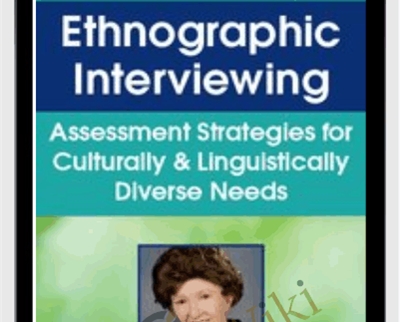
You are currently requesting access to the institutional-grade blueprint for Ethnographic Interviewing: Assessment Strategies for Culturally and Linguistically Diverse Needs – Carol Westby. This is a highly classified quantitative trading asset. Instant digital deployment and lifetime encrypted access are guaranteed immediately upon transaction clearance.
Salepage link: At HERE. Archive:
How do you know if you’re asking the right questions, to elicit the most pertinent information?
As clinicians, you must not only understand your clients’ impairment/disability but also see the world through their eyes.
In this recording, Dr. Carol Westby will explain how information gained through ethnographic interviewing – asking the right questions to the right person in the right way – can enable you to design assessments and interventions to meet your clients’ needs and goals.
You will learn how to conduct an ethnographic interview and analyze the information gained to:
- Identify barriers to client’s participation
- Convey respect
- Promote reciprocity
- Encourage responsiveness to the clients’ or families’ perspective
Ethnographic interviews can be used with all clients and their families and are critical when you don’t share their cultural/linguistic background. Video demonstrations are woven throughout the presentation to show the types of questions/interactions.
Participants will be able to:
- Assess the role of ethnographic interviewing in evidence-based practice and the International Classification of Functioning.
- Conduct an ethnographic interview to inform the clinician’s choice of treatment.
- Analyze interview data to establish intervention goals and objectives to improve client engagement.
Foundations for Clinical Assessment and Intervention
- Evidence-based practice (EBP) framework
- International Classification of Functioning framework
Ethnographic Question Types – Asking the Right Question in the Right Way
- Descriptive questions to help clients describe experiences, daily activities, objects, and people
- Grand tour and mini tour
- Example, experience, and native language
- Structural questions to determine relationships among ideas
Building Rapport
- Stages of rapport
- Problematic questions
- Questioning that facilitates rapport
Social Dimensions
- What they are
- Why to identify
Analyzing the Interview Data
- Domain analysis
- Identifying barriers and facilitators
- Determining strengths and needs
- Setting goals and objectives
Video demonstrations are woven throughout presentation to show the types questions/interactions
INSTITUTIONAL RISK DISCLOSURE: Trading foreign exchange, cryptocurrencies, and algorithmic assets on margin carries a high level of risk and may not be suitable for all investors. Past performance of any trading system or quantitative blueprint does not guarantee future results.

 Shadow Dancing - Derek Rydall
1 × $45
Shadow Dancing - Derek Rydall
1 × $45  Simple Lease Options 2020 - Joe Mccall
1 × $93
Simple Lease Options 2020 - Joe Mccall
1 × $93  Signs of Strength and Weakness - Gary Dayton
1 × $45
Signs of Strength and Weakness - Gary Dayton
1 × $45  Live Event Mastery Bootcamp - Angelique Rewers
1 × $44
Live Event Mastery Bootcamp - Angelique Rewers
1 × $44  Scientific Trading Machine - Nicola Delic
1 × $87
Scientific Trading Machine - Nicola Delic
1 × $87  LT Gamma Confirmation - Alessio Rastani
1 × $37
LT Gamma Confirmation - Alessio Rastani
1 × $37